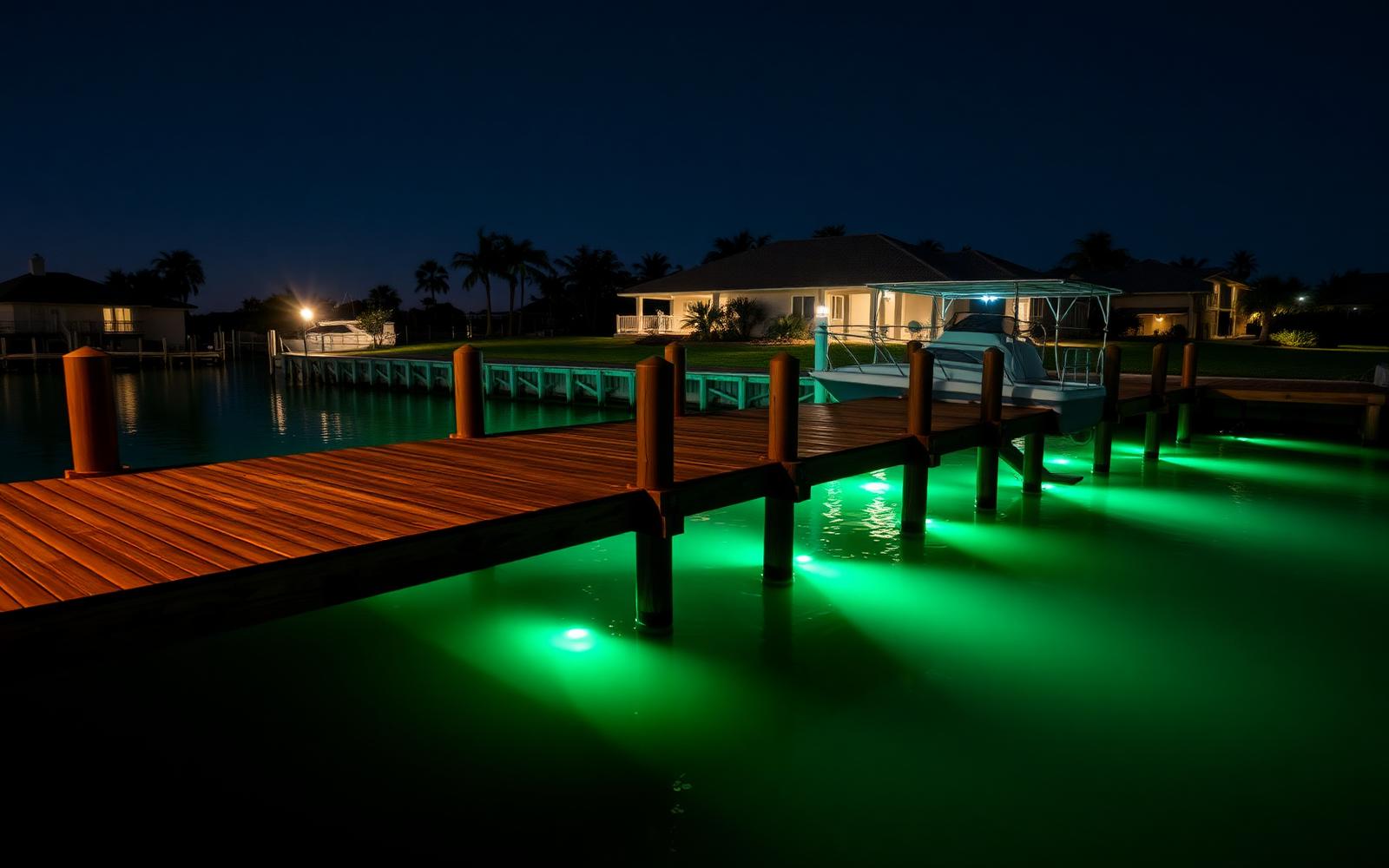
The ultimate guide to underwater dock lights and snook lights in Southwest Florida.
Everything we've learned installing marine dock lighting on canals, bays, and seawalls from Cape Coral to Marco Island — what actually works, and why.
What are snook lights?
A snook light is an underwater fishing light mounted beneath a dock, seawall, or boat lift so it shines through the water rather than across it. In Southwest Florida the name comes from the fish it reliably draws: snook stack along the edge of the glow at night, waiting for bait to drift through.
Functionally, a snook light and an underwater dock light are the same fixture used with different priorities. One is chosen for the fishing; the other for the look. A well-designed system does both at once — the water glows for the house, and the food chain shows up for the angler.
Why green underwater lights attract fish
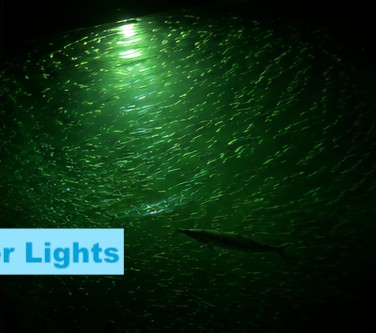
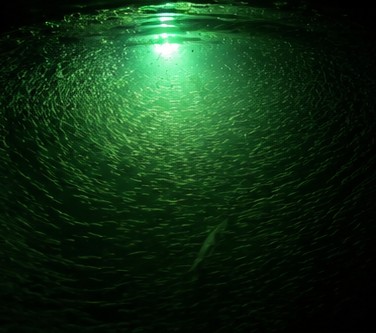
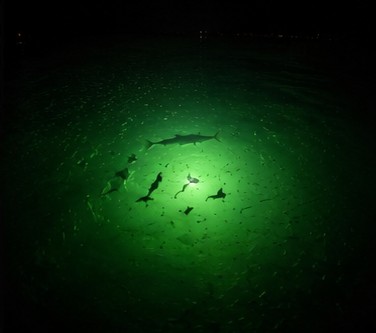
The chain starts small. Artificial light concentrates plankton and other micro organisms. Glass minnows, shrimp, and pilchards move in to feed on them. Within an hour or two of dark, predators — snook, tarpon, redfish, jacks, occasionally a cruising shark — settle into the shadow line to ambush the bait.
Green wins in our region because of water clarity. Gulf Coast canals carry tannin and suspended sediment that absorb red and much of the blue spectrum quickly. Green passes through that water farther, so the lit column is bigger and visible from more of the basin. A bigger lit column means more bait, and more bait means more fish.
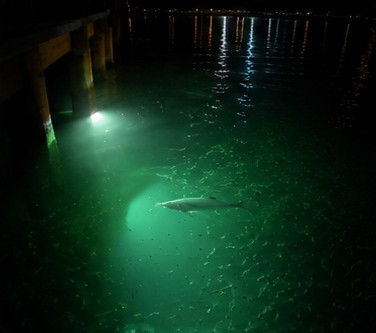
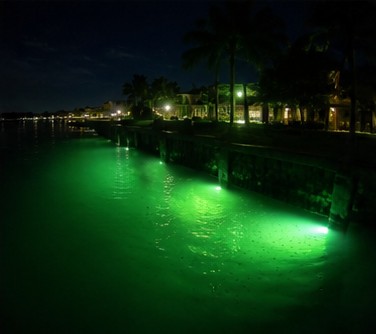
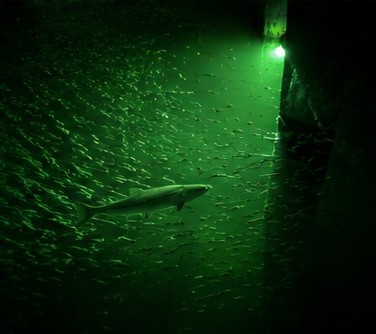
Green vs blue underwater dock lights
Green
The fishing standard. Maximum penetration in stained or moving canal water, the strongest bait response, and the classic Florida dock look neighbors recognize from across the canal.
Blue & white
The luxury look. In clear water blue reads modern and yacht-like, pairs beautifully with contemporary architecture, and shows off hull lines. It attracts fewer fish than green in most of our canals.
You do not have to choose permanently. Color-changing RGBW fixtures let you run green on fishing nights and switch to a cool blue or white when you're entertaining. That flexibility is why most of our recent installs are color-changing.
Where underwater lights should be installed
- Along the dock face. Fixtures mounted on pilings or under the dock edge light the water where fish already travel and hide the fixture itself from view.
- At the boat lift. Light between the bunks makes night loading safer and adds a dramatic under-hull glow.
- Along seawalls. A run of evenly spaced fixtures turns the entire waterline into a continuous ribbon of light.
- At the canal mouth or dock end. The deepest, highest-current spot usually produces the most consistent fishing.
Depth matters as much as position. We generally set fixtures 12 to 24 inches below the low-tide line, angled to avoid glare toward the house or the neighbor's dock, then verify the aim after dark on installation night.
How many lights does my dock need?
| Structure | Typical fixtures |
|---|---|
| Small private dock (up to 20 ft) | 1 – 2 |
| Standard canal dock (20 – 40 ft) | 2 – 4 |
| Dock with boat lift | 3 – 5 |
| Seawall run (per 100 ft) | 6 – 8 |
| Marina slip row | 1 per slip, minimum |
The practical rule: one fixture every 10 to 15 feet. Wider spacing leaves dark gaps that make a dock look patchy rather than designed. Deeper or more turbid water usually calls for one more fixture than the table suggests.
Benefits beyond fishing
Luxury waterfront ambiance
The water becomes the feature of the property after sunset instead of a black void beyond the lanai.
Nighttime entertaining
Guests gather at the dock. Lit water turns an ordinary evening outside into an experience.
Increased property value
Dock lighting is a visible, photograph-ready upgrade that helps waterfront listings stand out.
Dock visibility and safety
Illuminated edges, pilings, and lift bunks make walking and docking after dark far safer.
Waterfront aesthetics
Glow reveals water clarity, movement, and depth — texture no landscape light can produce.
Wildlife watching
Bait schools, snook, tarpon, and the occasional manatee become nightly entertainment.
Professional installation process
- 01Site visit and water readWe walk the dock, check depth, current, clarity, and power access, and talk through how you use the water.
- 02Lighting planYou get a fixture count, placement map, color recommendation, and a firm price before anything is ordered.
- 03Electrical and mountingLow-voltage transformers, marine connectors, strain relief, and concealed cable runs — installed to code.
- 04Night aim and walkthroughWe return after dark to tune aim and spacing, then show you the controls and the maintenance routine.
- 05Ongoing carePeriodic cleaning keeps output bright. We service what we install, and we retrofit systems others left behind.
Frequently asked questions
How deep should an underwater dock light be mounted?
Most Southwest Florida canal installs sit 12 to 24 inches below the low-tide waterline. Too shallow and the light scatters at the surface; too deep and silt and algae dim it quickly.
Green or blue underwater dock lights — which is better?
Green is the proven fish attractor because green wavelengths travel farthest through the slightly stained water of Gulf Coast canals. Blue and white read cleaner and more modern in clear water and around yachts. Many homeowners choose color-changing fixtures and run green when they want fish.
How many underwater lights does my dock need?
A typical 20 to 30 foot private dock looks balanced with two to four fixtures. Larger docks, boat lifts, and seawall runs usually need one fixture every 10 to 15 feet to avoid dark gaps between pools of light.
Do underwater dock lights use much electricity?
Modern marine LED fixtures typically draw a fraction of the power of older halogen units, so a full residential system usually costs only a few dollars a month to run nightly.
Will lights survive Florida storms and salt water?
Properly specified fixtures are fully sealed, corrosion-rated, and installed with marine connectors and strain relief. We mount them so they can be serviced or removed without cutting into your dock.
Do I need a permit for dock lighting?
Requirements vary by municipality and HOA. Most residential low-voltage installs are straightforward, and we handle the electrical work to code and advise you on anything your community requires.
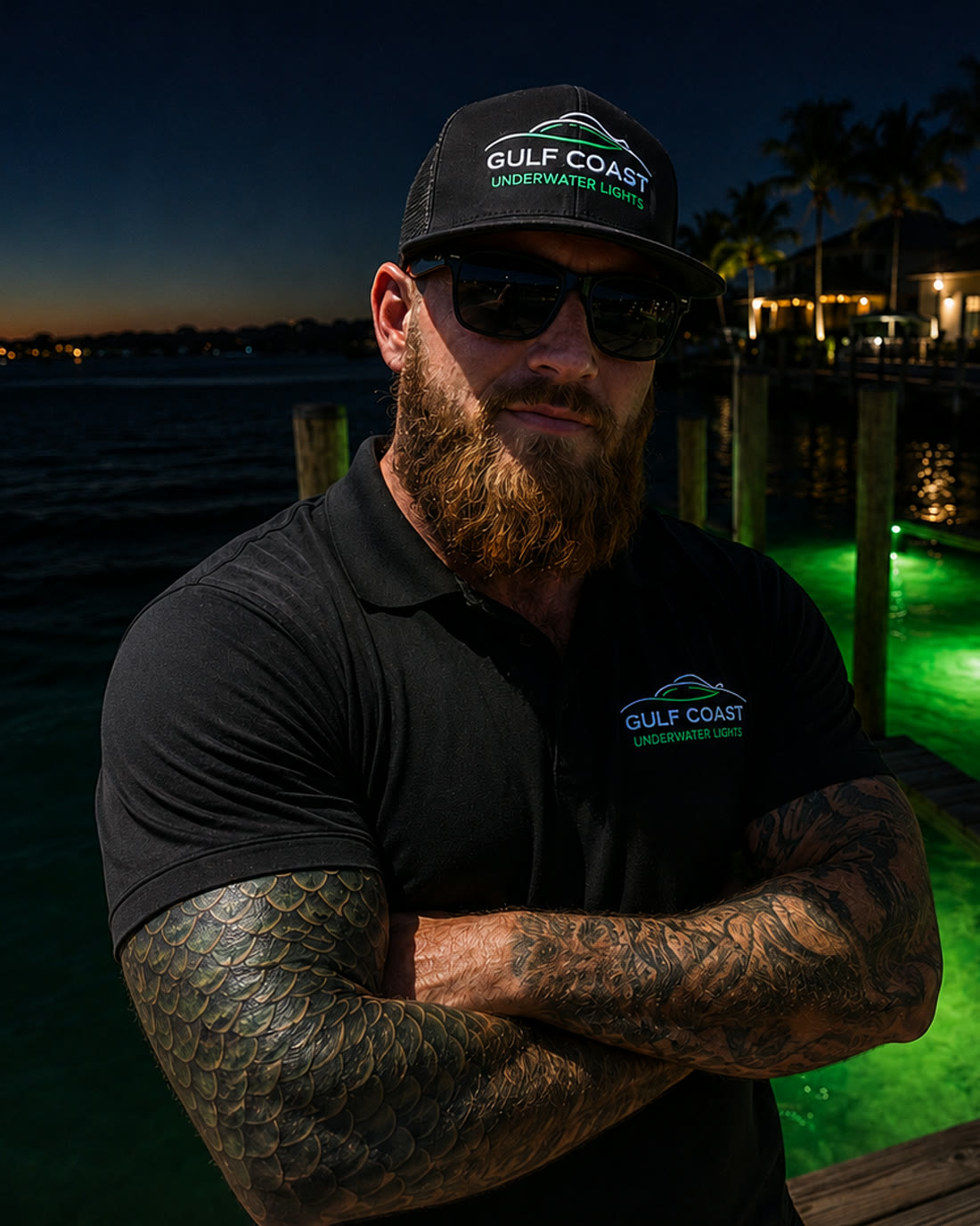
Written from the dock by Christopher Hamilton — owner and installer, Gulf Coast Underwater Lights.
Ready to see your water glow?
Christopher Hamilton designs and installs every system personally, throughout Cape Coral, Fort Myers, Fort Myers Beach, Sanibel, Captiva, Pine Island and the rest of Southwest Florida.
Prefer to look first? Browse recent installations.